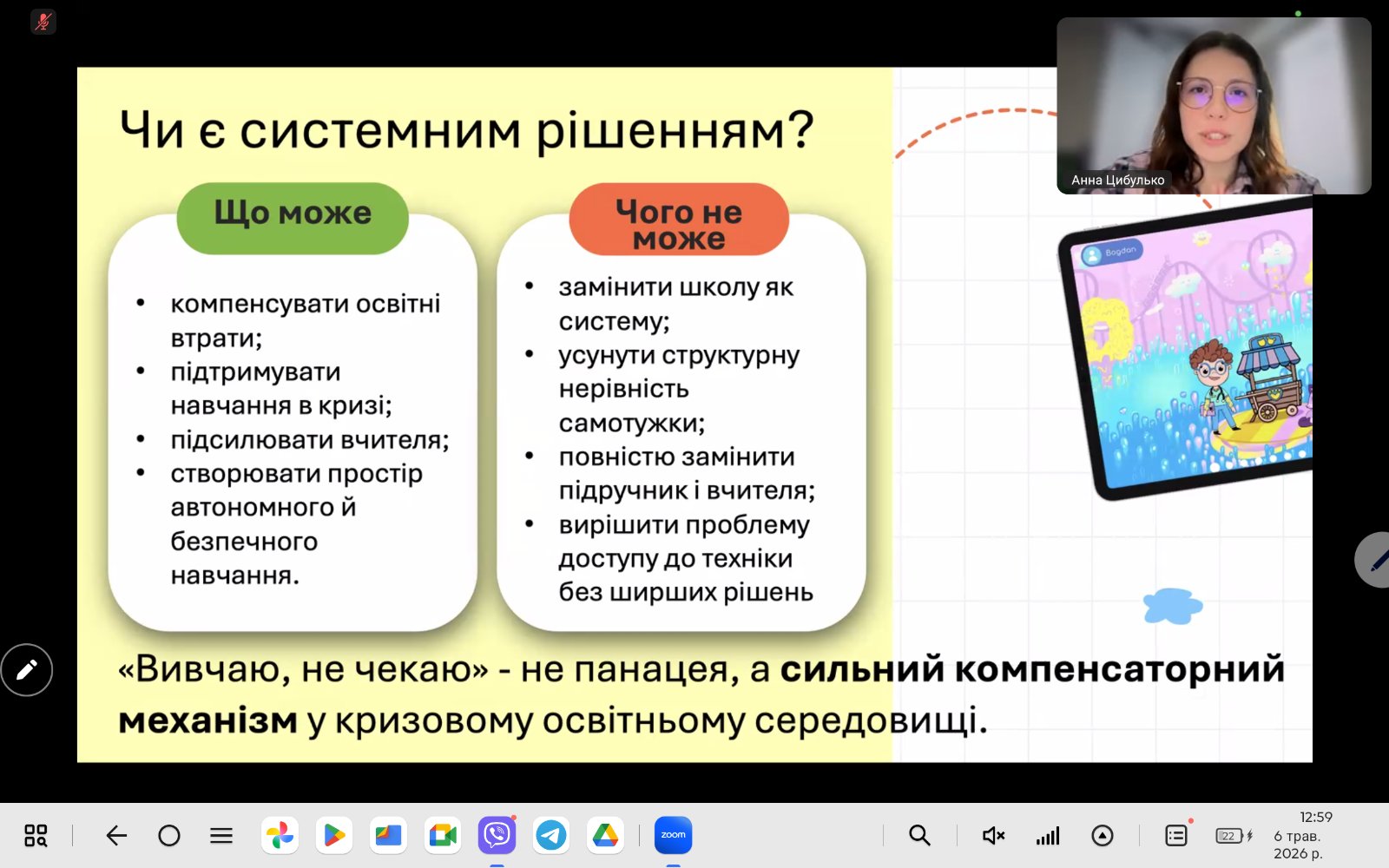
Within the framework of the IV International Scientific and Practical Conference “Current Issues of Personality Development: Modernity, Innovation, and Prospects”, held on May 6, 2026, at the Faculty of Social and Psychological Education of Zhytomyr Ivan Franko State University, a study on the potential of digital tools in promoting inclusive primary education was presented by Anna Tsybulko, using the case of the Can’t Wait to Learn programme.
 The Study of the Can’t Wait to Learn Programme in Ukraine is being implemented by War Child Alliance. Under the service agreement, the Ukrainian Educational Research Association conducted the field phase of a quasi-experimental study involving 36 schools in Cherkasy Region. The research was carried out between January and June 2025.
The presentation focused on the potential of digital tools to reduce educational inequality and foster inclusion across key dimensions, including access, participation, learning outcomes, and safety.
The researchers emphasised that the Can't Wait to Learn program serves as a powerful compensatory mechanism within crisis-affected educational environments. Technology does not replace the teacher; rather, it strengthens the teacher’s role by enabling part of the class to work autonomously while the teacher provides individualised support to students who need it most. According to the study findings, the successful integration of digital tools depends, among other factors, on cultivating a culture of collaboration in which such tools are used to support children with special educational needs without overburdening teachers or disrupting the learning process in the classroom.
Following the presentation, the conference participants highlighted the relevance of the study in the context of ongoing transformations in the educational landscape, the importance of a comprehensive approach to evaluating the effectiveness of digital solutions, and the need for further research on scaling and adapting digital tools to meet the needs of children with special educational needs across diverse educational contexts.